


Time management is for whom?
Time management is for whom?
What is Time Management? What do you think of when you are asked that question? Costs, profitability, overtime, workload... There are many things to consider, but most of them are probably for "management. "Management" is naturally necessary, but don't you think it would be a shame not to use the man-hour data you have collected for "improvement"?
In this article, we would like to introduce "Time Management" that lead to "improvement" in the field, based on DENSO Create's experience in improvement activities.
![[Column] Chiaki Takeshita (IOTA Promotion Department, DENSO CREATE INC.)](/concept/column/images/01-03/img-intro-interviewee.jpg)
There is a gap between the "manager-led time management" and the actual situation at the site.
"Management" is important to minimize losses as a company and organization and to generate profits.
However, when Time Management is conducted mainly by the administrator, the following differences may occur between the site and the site.
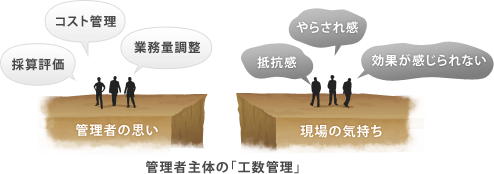
Time Management from the manager's point of view
Considering the role of a manager, it is natural to want to visualize the profitability of a project or organization and to know the load on members in order to adjust the workload. For this purpose, we ask the site to report the man-hours.
Profitability and burden are the total number of man-hours per project or project in a certain period of time. Administrators evaluate the "outcomes" and make good or bad decisions about profitability. They instruct, instruct, and, in some cases, pursue project PM and adjust their workload and resources so that Actual time and overtime are leveled.
In other words, in an administrator-driven Time Management, the process and content are not very relevant,The only evaluation and judgment criteria will be "man-hours spent (results).However, there are many things that do not show up in the total man-hours (results), such as the various innovations and efforts made in the field due to the circumstances of the field, and the fact that people who do not work overtime do not necessarily have a low workload.
On-site workers are reluctant to control man-hours.
Evaluating profitability and adjusting workload and resources are important roles for managers, but from the point of view of the field, it is not surprising that reporting man-hours may lead to strict instructions, pursuits, and high demands from managers, as well as unexpected job content and reassignment.
In addition, if the process is not evaluated and is evaluated in terms of total man-hours (results), the field may feel uncomfortable with the manager seeing the man-hours, or may manipulate the data to show it to the manager. As required by the administrator,On-site workers tabulate man-hours "for managers" and repeatedly report man-hours with a sense of being forced to do so, without feeling happy for themselves.This is a good idea.
If this happens, no matter how much the administrator asks for man-hour reports, evaluates them, and tries to manage them, the results will not be as good as expected.
Column: visible in man-hours
Man-hours can be thought of as an output that can always be obtained regardless of the nature of the work or the person in charge. It can also be measured in a common unit of time. It may be said that man-hours is the only output that is always obtained and has a common unit.
If you have a WBS(Work Breakdown Structure) and can measure the man-hours for each task, you will be able to see what, who, and how much man-hours were spent on what. By doing so, you will be able to see specific areas for improvement, such as efficiency/bad points, and the amount of rework (redo work).
In TimeTracker RX, enter the man-hours using the "time sheet" function. Since the Timesheet looks like a calendar,You can see not only what, who, and how much man-hours were spent on it, but also the time frame of when.This makes it possible to see not only the time of simple individual work, but also the order and timing of the work, and even the daily work of each individual.
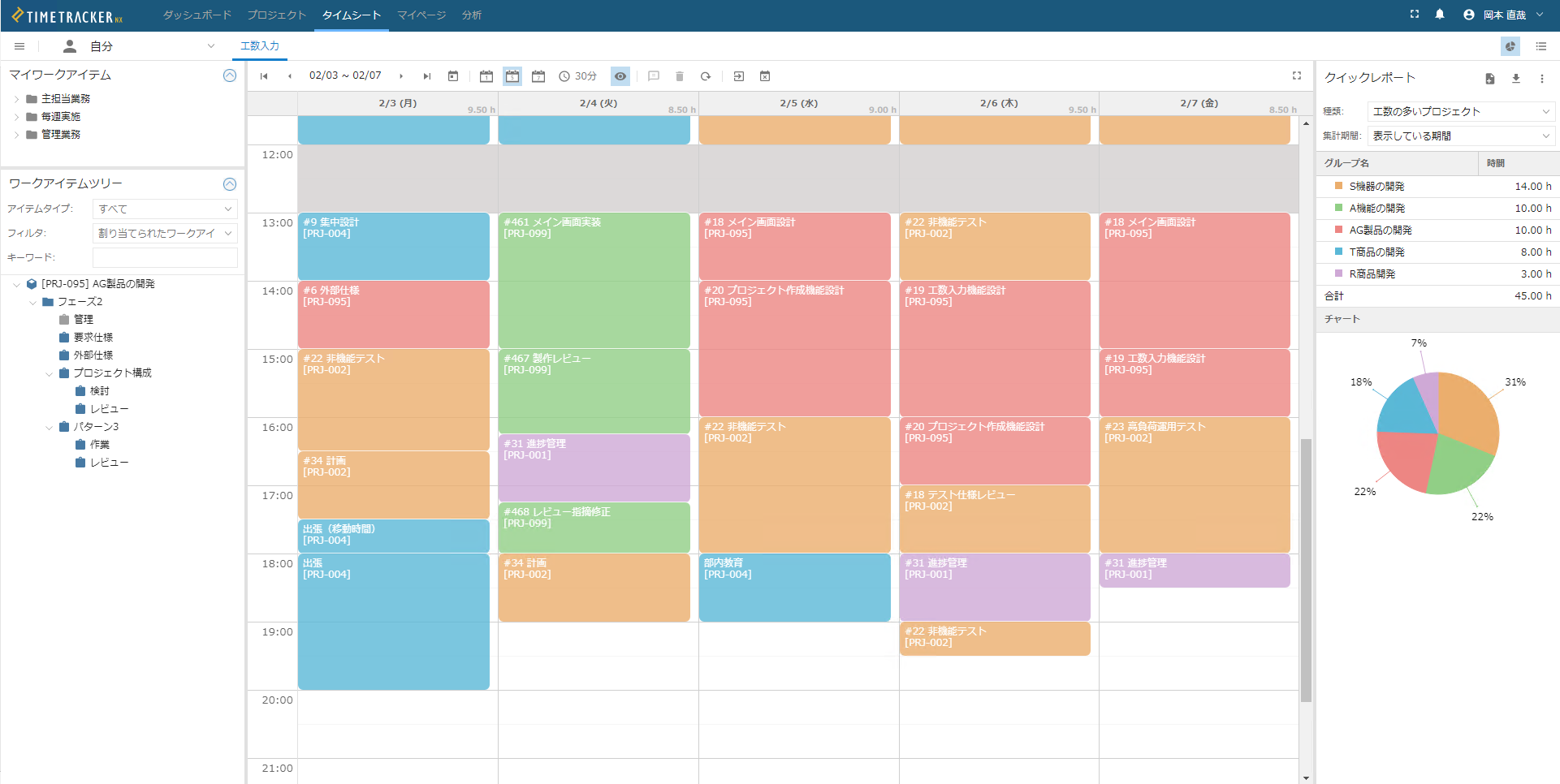
TimeTracker RX time sheet is
Understand when, what, who, and how much man-hours were spent
"Improvement" changes from the site perspective of "time management"
Be able to face the facts and make improvements
In many workplaces, you may have the desire to reduce rework, improve quality, and reduce overburden, waste, and unevenness.
As mentioned earlier,From the man-hours, we can see "improvements in business and work" and "daily work performance". If you make good use of it, you can get a clue to improvement.If you know the specific "quantity", such as how much man-hours are spent on rework and troubleshooting, or how much man-hours are spent on reviews, it will be easier to get a rough idea of how much improvement should be made and how much is appropriate.
Also, when work does not go as planned, we often tend to think that there are many interruptions, but when we look at the "timesheet," we can see that there are actually other factors. Man-hours tell us the "facts" of the present.
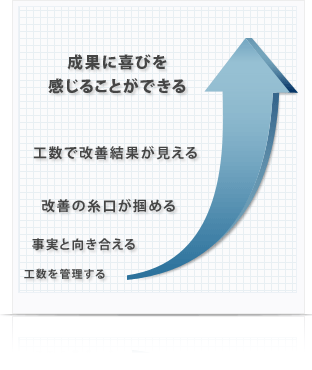
Make it more fun to see the results
The result of working on improvements based on the "facts" that have come to light will also show up in the man-hours.The man-hours tell us the effect of improvement.It's a great way to get to know the people you'll be meeting. If you can feel joy in the results, you will be motivated and happy to improve.
Improvement activities themselves are difficult to measure, so it is easy to get frustrated without feeling the effects, but by using man-hours and visualizing the effects, you will feel joy in the results and it will be easier to continue.
When used in the field, accuracy increases.
When you start working on improvement activities using man-hours, you will have more opportunities to look at man-hours and want accurate data, so the accuracy of man-hours will gradually improve.Once the frontline is able to experience the effects, the motivation to correctly collect man-hours will increase.So the accuracy is even better. As a result, the quality of the data used in the field for improvement has improved,As data that requires an administrator, it naturally increases in accuracy.
In the past, sites were reluctant to report data to administrators because they were evaluated and swayed by "custom-made" data for them, but now that administrators can make decisions based on accurate data, they will be more receptive.
At the site,Use man-hours as data for our own improvementThis will make both the manager and the field happy.
Time Management is for you.
To whom is Time Management for?
In the first place, it is strange to say that it is for someone else's sake, but if I had to say, it is for the sake of "myself" who is outputting man-hours.
I think one of the proofs of my hard work and ingenuity is the man-hours I spend fighting various problems every day. There are failures and successes, but why not face yourself and yourself (your team) through man-hours?
DENSO Create promotes improvement activities based on the motto of "Everyone at the site notices and makes improvements on his or her own. TimeTracker RX has become an essential part of this process. TimeTracker RX is a Time Management and project-management function that supports kaizen activities.A tool that supports the creation and continuation of kaizen activities from the frontline and allows the frontline to experience joyThat's TimeTracker RX.