


Case Studies
Supporting efforts to comply with
ISO26262 on
a tooling basis
Build a development environment that
leverages each tool's strengths through integration


JTEKT Corporation
 What are some of the issues that need to be addressed before implementation?
Functional safety initiatives
To develop high-performance, high-safety automotive components, ISO26262 functional safety standard has been issued. In order to comply with ISO26262, we decided to implement a Application Lifecycle Management tooling environment ("ALM tooling") to strengthen requirements-management, process-management, and SCM. In addition, by using ALM toolworkflow control, we were able to promote compliance with the industry-standard process model (Automotive-SPICE(A-SPICE) for developing in-vehicle embedded software, which we were working on at the same time.
In this way, we have been promoting compliance with ISO26262 and A-SPICE, but one issue has emerged.
I want to create and manage planning in Gantt Chart
We can foresee that the introduction of ALM will enable requirements-management and process-management and SCM in compliance with ISO26262. However, planning and resource management in the field of product development requires coordination among teams and members. In the past, this schedule was managed by drawing a Gantt Chart on Excel. We thought that if we could manage the schedule in Gantt Chart even with the new system, it would be easier for the field to get used to it and we would be able to manage it more effectively.
However, although ALM system we were planning to introduce had a function to manage planning data, the planning method was different from our conventional method, and the operability was not satisfactory for the purpose of managing the schedule of the development site.
I also had this problem.
- ・The accuracy of Actual time was low.
The effort results were tabulated by Excel, but since the plan and results were managed separately, there was an inconsistency between the granularity to be entered and the granularity of the plan. As a result, it was difficult to use it for analysis, reflection, and as a basis for estimating the next project.
Why was TimeTracker adopted?
Visual schedule control and easy-to-use Time Management match the needs of the field
When I was looking for a commercial tool that could manage my schedule by Gantt Chart, I found out about TimeTracker RX. The first thing I liked about TimeTracker RX was that it had Gantt Chart planning and schedule management functions and was easy to use. In addition, it has a full range of management and visualization functions that are required by the field, such as confirmation of man-hours and progress forecasts, and I could imagine that the field would be impressed by its flexibility and ease of familiarity. We felt that this would allow us to operate the system without placing a burden on the inputters and administrators compared to conventional Excel control, so we decided to promote full-scale assessment.
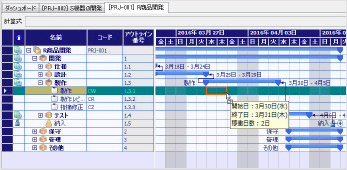
Schedule control by Gantt Chart
In the first place, I believe that "compliance with standards" does not mean performing tasks according to a set schedule, but rather "improving the existing system to comply with the standards," in other words, "continuing to improve the system through PDCA cycle. In other words, "continuing to improve the system to comply with the standards. In this regard, we believe that by using TimeTracker to collect and analyze actual results based on man-hours, we will be able to find areas for improvement on our own and promote activities to cycle through improvement.
How did you proceed with the introduction?
Leveraging the strengths of each tool for coordinated operation
TimeTracker makes it easy to revise plans in response to workplace conditions, while product development schedules require controlled changes. Our ALM tool requires rule-based procedures to change an entered plan, making it well suited to product development scheduling. Because each tool
has different strengths and limitations, we integrated the ALM tool with TimeTracker and exchange data between them. As requirements become more complex, no single tool can satisfy every need. Users must combine the strengths of each tool effectively to meet their objectives.

Tool Synchronization image
As a concrete measure, we have decided to create a product development schedule for ALM Tool. At TimeTracker, we have decided to create a development schedule for the site. By inputting actual results such as man-hours and progress-rate in TimeTracker and reflecting them in ALM tooling, we were able to manage both the product-development schedule and the development site schedule. We needed to use TimeTracker's API to realize cooperation between systems, so we first introduced a small test system and spent about six months building a system that would cooperate with each other.
How did it work?
I am now able to manage schedules from the product and site perspectives.
We manage product development schedules in the ALM tool and workplace schedules in TimeTracker, allowing progress to be viewed from both perspectives. The development teams accepted the system without resistance because they could continue planning with familiar Gantt charts. For the
PDCA cycle, we can now compare plans with actual results—the “PD” stage. Our next step is to identify improvement opportunities from the accumulated data and begin the check-and-act cycle, helping us establish a development organization that truly conforms to ISO 26262.
It also had this effect.
Estimation accuracy was improved by improving the accuracy of Actual time and the correlation between the result and the man-hour.
TimeTracker manages planning and performance in an integrated manner, which improves the accuracy of Actual time results. In addition, the integration of ALM and TimeTracker seamlessly connects process management, SCM and Time Management, and links deliverables to man-hours. This makes it possible to make more accurate estimates by referring to the deliverables and man-hours of the previous project when planning a project. I also think that the planning process itself is easy to do.
Customer comments
| Industry classification | Machine |
|---|---|
| Description of Businesses | Manufacture and sale of steering systems, bearings, machine tools, etc. |
| Business Introduction | Supplies customers with the world's leading product and one-of-a-kind technology as a system supplier of automotive parts, bearings, and machine tools. Especially in electric power steering, it succeeded in developing and mass-producing the world's first, and boasts the world's top share. |
| Departments introducing | Design and production engineering divisions |
| Web website | https://www.jtekt.co.jp/ |
- [TKC Corporation] Standardizing service processes and repeating improvement cycle to realize improvement of efficiency!
- [Sumitomo Metal Mining Co., Ltd.] For fair charging in shared services, grasping actual status of work
- [MTI Ltd.] Improved accuracy of reporting data without placing a burden on the site
- [TEAC Corporation] Speedy and accurate in actual time compilation process
- [LSI Japan Co., Ltd.] Generated stable profits with understanding work of members in a telework environment and realizing highly accurate estimates
Customer comments
TimeTracker has the functions and qualities required by the development field, and I feel that it's genuinely software that attends to every last detail. I believe that's unique to domestically produced software born from development sites in Japan. We haven't yet achieved everything we want to do, so we're looking forward to further expanding our use of TimeTracker's Web API and other capabilities.
JTEKT Corporation
Mr. Masu, General Manager of the 2nd Development Office, System Development Department