


Processing improvement cycle with CAPDo
Processing improvement cycle with CAPDo
When it comes to project management, it is not only necessary to make a plan and check the progress of the work, but also to conduct continuous improvement activities. The term "PDCA" is well known as a typical improvement cycling method, but have you ever heard of "CAPDo"? In this article, I would like to explain what kind of improvement method CAPDo is and the relation between CAPDo and TimeTracker RX.
![[Column] Junji Kuriyama (IOTA Promotion Department, DENSO CREATE INC.)](/concept/column/images/02-03/img-intro-interviewee.jpg)
Why the PDCA Improvement Cycle Fails to Work
Before we talk about CAPDo, let's take a look at the basic concept of PDCA.
What is PDCA?
PDCA is a method of improving quality and production control in project management and operations, and was proposed by W. Edwards Deming, the father of quality control, and others.
A single character in a PDCA has the following semantics:
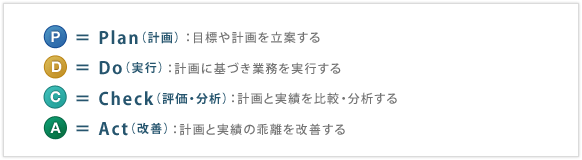
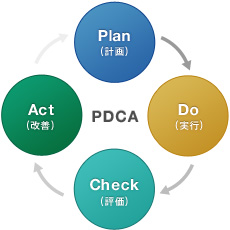
PDCA aims to continue its improvement activities by repeating the four activities from planning (Plan) to implementation (Do), evaluation/analysis (Check) to improvement (Act) in one cycle.
This PDCA cycle is used not only for quality-control and manufacturing-control, but also for general-purpose business and project-improvement. In addition, there are organizational-level PDCA as well as individual-level ones, and nowadays, these are basic terms widely used by businessmen regardless of industry or industry.
Difficulty on cycling PDCA
"Let's go around PDCA cycle!" I began to work on the improvement. Have you ever experienced a failure on the way or a failure to finish the improvement once?
If you actually try to run PDCA cycle, you will find the following difficulties.
- In many cases, they stumble on "Plan"
- "Planning (Plan)" is established, but it does not lead to "Evaluation/Analysis (Check)" or "Improvement (Act)"
- Unable to collect performance data (evaluation data) for "evaluation/analysis (Check)" and "Act"
- There is a large gap between " Act" and "Plan," and even if one cycle is completed, it will be a one-off event.
Common patterns include the following.
・You spend too much time on the initial planning, and you run out of steam with "P" (= Plan) before PDCA one.
・Even if the planning is done, the subsequent verification phase, "C" (= Check), involves measurement, and the measurement activities themselves are difficult.
・Because they start from a plan without understanding the current situation, the plan itself becomes unreasonable and ends in failure.
In this way,A good PDCA can only be achieved through a cycle-of-improvementAnd yet, until you can run PCDCA systematicallyIn many cases, it does not turn once or even once, and the original effect cannot be obtainedThis is the reality of the field.
The Improvement Cycle Starts Moving with CAPDo
As you can see, PDCA is very simple, but many people find it difficult to actually improve it on a continuous basis. In view of this,The "CAPDo" method was devised to make it possible to improve as much as possible.
What is CAPDo?
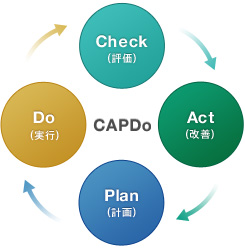
CAPDo is an improvement-cycle method in which the order of PDCA is changed and "C (= Check)" is introduced at the beginning for PDCA who make difficult planning at the beginning. In other words,Understand the current situation before making improvements.That's why.
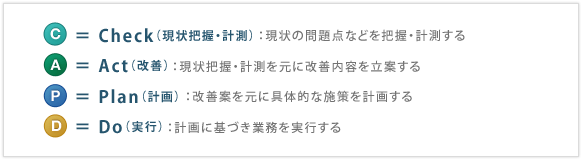
In addition to simply starting with "Check," in CAPDo, the "Act" phase is often used to determine what needs to be done, and the same "Act" may mean different things in PDCA and CAPDo as follows.
・PDCA: "Improving Deviations Between Planned and Actual Results"
・CAPDo: "Planning of remedial policies"
In PDCA, there is a large gap between improvement (Act) and subsequent planning (Plan), and the cycle does not circulate. With CAPDo, there is a continuity between improvement planning and policy planning, and the cycle flows smoothly.
This difference allows the cycle of improvement to run uninterrupted.
"CAPDo" with an emphasis on continuity and practical remediation
When you actually apply CAPDo to your business, you will find that CAPDo of understanding the current situation first, making an estimate, and then considering a plan to improve the situation is less difficult and easier to do than PDCA where planning is the starting point. In addition, CAPDo don't need planning first.It is easy to begin lightly,Can start improving more quicklyThis is also the case. This is very important. This is because the shorter the cycle of improvement, the faster the results of improvement will be obtained, and the easier it will be to lead to the next improvement. Improvement is not a one-time event, but it is important to continue (repeat the improvement cycle). The low threshold and speedy cycle are also effective for this "continuity".
For example, we can improve operations to reduce unnecessary work such as rework, and improve estimates to improve the accuracy of estimates based on actual results.CAPDo is ideal for practical kaizen activities that are meaningful to be repeated in a short cycle.It's a great way to get to know the people you'll be meeting. I often use PDCA instead of CAPDo in my projects. However, since I started applying CAPDo, I have been able to improve things that I was too prepared to make progress on.
It's not limited to CAPDo, but I think it's easier to get used to the system and create a culture if you try to improve little by little, starting with small things. The key to making improvement activities take root in the workplace is to gradually increase the size of the small cycle.
TimeTracker RX Works Well with CAPDo
In order to improve CAPDo, it is essential to understand and measure the current situation (Check). The key is how quickly you can grasp the facts and how accurate the data is. Of course, since improvement is an ongoing activity, it is also important that there is no burden on measurement. In order to do this, you will also need the support of tools.
Especially in the case of knowledge workers, man-hours are often used to understand the current situation. Man-hours are a very important factor in improving cost and productivity. For TimeTracker RX,With the product concept of "starting by grasping the facts without making a plan," it is possible to accurately measure man-hours (i.e., the facts of knowledge workers) without burden and quickly visualize the current situation.It has features. And since the effects of improvements can be visualized, we can feel the joy of growth, and as a result, improvement activities will naturally become more active. From this point of view, TimeTracker RX is a very good match for CAPDo of continuous, short-cycle kaizen activities.
If you are worried that you will not be able to continue your kaizen activities, why don't you start with a TimeTracker RX to understand the current situation?