


Aiming to keep entering work time and to improve its accuracy
Aiming to keep entering work time and to improve its accuracy
Measurement is an integral part of project-management and process-improvement, but "Input work time (measurement) does not take root"
I'm sure there are many people who have the problem of not being able to gather the right man-hours.
In this article, I would like to introduce what I have learned about the mechanism by which Input work time is difficult to take root and how it can be said to take root and be highly accurate.
![[Column] Chiaki Takeshita, IOTA Promotion Department, DENSO CREATE INC.](/concept/column/images/01-01/img-intro-author.jpg)
Why input work time don't stick
We have prepared a system for inputting man-hours using Excel and Time Management tools.
"Let's get man-hours results!" "Let's add man-hours every day!"
I often start working on it, but it doesn't work.
Why doesn't it work to start with the desire to "improve" or "make it better"?
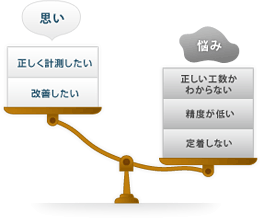
What is the consolidation of input work time?
In the first place, what is the status of Input work time retention? Even if you have a good Actual time, it is difficult to determine whether it is really retention or correct.
Although there may be various interpretations,"Effort for the day is entered every day" statusI think you can call it retention if you can maintain the.
Why "every day"? It's difficult to enter the man-hours correctly if you put them together weekly, much less monthly, for that time frame, and I guess you can't say that Input work time has become an everyday activity.
The first step to retention is to put in a lot of man-hours on a daily basis, in other words, to "enter data every day.
There is no "post-process" in daily input work time
There is always a "post-process" to various tasks in a business. The post-process may be the work of the next process, approval, confirmation, etc. It depends on the work and activity, but the presence of the post-process naturally accomplishes the work of the previous process.
But what about Input work time? I'm sure there's a time, once a week or once a month, when you're doing a project/organizational tally, but if I had to say, that's the post-process.
However, as mentioned in the previous section, retention is "typing every day". For weekly and monthly aggregations, it does not matter if the data is entered every day or not, as it only needs to be the total value of the data within that period. In other words,Even if you don't do it, "daily Input work time" is a task that you don't feel the need to do because it won't bother the post-process.This is why it is difficult for them to take root.
Inconsistencies that require man-hours to input work time
Since you start measuring man-hours for some purpose, you should tally them in units of weeks, months, project phases, etc. Even if the daily input is not well established, when the time comes for the tally, you will always be followed up and input the man-hours all at once. However, it is very inefficient.
It is most efficient to add man-hours every day and every time.
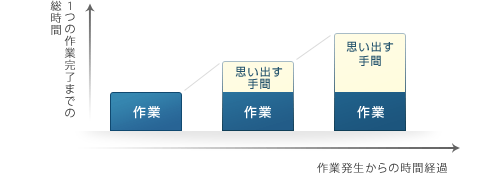
At the end of the day, I will be able to remember somewhat accurately what I was doing today. However, when it comes to a week's worth, a month's worth, or a few months' worth, it is difficult and impossible to remember exactly what happened during that period. It takes time to remember that, and it takes time because you will be entering a lot of man-hours. This leads to the contradiction that man-hours are spent to input man-hours, in other words, man-hours are measured for improvement and efficiency, but extra man-hours are spent.
Considering the time and effort required to recall and enter the data, it is actually easier to enter the man-hours for the day every day of the day.Furthermore, if you type it in at each break in the day, you don't have to remember it and the typing itself takes only a few seconds. The hours of Input work time work that used to be done on a weekly or monthly basis can be reduced to almost nothing by simply doing it every day or every time.
Column: the simpler things, the more difficult they become to implement over time
A little digression,Things that don't take long to finish on the spot become more difficult over timeThere are many things that we do in our business. Input work time are typical, but so are minutes and responding to small requests.
They all have in common the act of "remembering". As time goes by, memories fade, so it takes time to recall them, and they lose their accuracy. This makes it difficult to execute properly.
Furthermore, as they say, "When dust piles up, it becomes a mountain," and even if each task is small, it becomes bigger and bigger as it accumulates. The trouble is, unlike just chili, it doesn't just increase in number, but each one of them increases more than the original effort, so it becomes an exponential increase and one day it will get out of hand.
Just reducing the amount of "remembering" may have a surprisingly big effect.
When the input is fixed each time, the accuracy naturally increases
Even if man-hours are entered every day, just because you are entering them while your memory is still fresh does not necessarily mean that they are highly accurate. Of course, if you compare it to when it was once a week or once a month, it will be more accurate. However, in the beginning, you may have a habit of putting them all together, and it is not uncommon for your manager or boss to follow you up and ask you to put them in every day, so you may be putting them in all together every day.
However, if you persevere and continue to put it in every day, you will see the following changes.
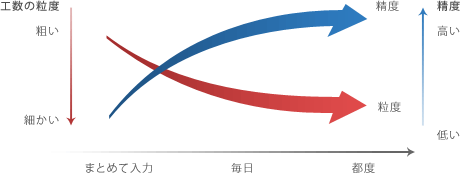
When fixed, the granularity of man-hours becomes finer
As you start entering man-hours every day, you realize that it is easier and more efficient to enter them at each break in the work than at the end of the day, and you gradually develop the habit of entering them each time. If you enter man-hours each time, you will be able to do each task,As you become more aware of the time it takes, the units of input will become finer and finer.This means that the grain size becomes finer.
At first, Actual time was roughly divided into "designing a certain part of the work," "reviewing it," "correcting points," and so on, but at each break in the work, it changed to "designing a certain part," "reviewing it," "correcting points," and so on.
You can collect specific, detailed, and highly accurate results without any hassle or extra man-hours because you put them in each time. When this happens, you will really be able to maintain your daily Input work time and improve your accuracy.
Need time to settle
It will take a while to be able to collect Actual time at a fine granularity by entering man-hours every day. There are many people who take root quickly on an individual basis, but when it comes to taking root in the entire organization, you should expect it to take six months to several years, and another six months for the granularity to become finer.
Foster a culture
As I mentioned in the previous section, Input work time is of the quality of "getting into habits," which in other words means "fostering a culture. It takes time to cultivate a climate. If you rush the results too quickly, you may end up tying them up with too strong management or giving up halfway through.
TimeTracker RX is designed to be easy to type, such as intuitive to operate, and helps to fix Input work time and improve accuracy by reducing the time and effort required to make Input work time. Once it becomes a "climate," it is easy to maintain. I recommend that you do not rush to work on it.